
Toe Walking in Children: When to Worry and What Helps

By Dr. Christopher Correa, DPM, FACFAS, Select Foot & Ankle Specialists, Cypress, TX
A child who walks on tiptoes can look playful at first. Then it happens again. And again. Soon, parents start wondering if it is a habit, a phase, or a sign that something needs attention.
Toe walking means a child walks on the balls of the feet while the heels stay off the ground. It is common in toddlers who are still learning balance and coordination. Many children grow out of it without treatment. But when a child keeps walking this way past age 2 or 3, or cannot place the heels down when asked, it is time for an evaluation.
At Select Foot & Ankle Specialists in Cypress, TX, Dr. Christopher Correa evaluates children with toe walking, tight Achilles tendons, gait concerns, and related foot and ankle issues. The goal is not to worry families. The goal is to understand why it is happening and help the child walk comfortably and safely.

Toe walking can be normal in very young children
In children under 2 years old, tiptoe walking is often part of normal development. Toddlers are still figuring out how to balance, strengthen their legs, and coordinate each step. Some rise onto their toes when excited, walking fast, or exploring new surfaces.
Many toddlers can still bring their heels down when standing or walking slowly. They may switch between flat-foot walking and tiptoe walking throughout the day. That kind of mixed pattern is usually less concerning than a child who always walks on the toes and cannot comfortably lower the heels.
By age 2 to 3, many children settle into a heel-to-toe walking pattern. If toe walking continues beyond that point, it deserves a closer look. The evaluation can help separate a common developmental habit from a tight tendon, orthopedic condition, neurologic concern, or sensory-related pattern.
Signs that toe walking should be evaluated
Parents do not need to panic over occasional tiptoe steps. The pattern matters more than one isolated moment.
A podiatric evaluation is a good idea if a child:
Walks on tiptoes most of the time after age 2 or 3
Cannot stand with both heels flat on the floor
Walks on one toe more than the other
Complains of foot, ankle, calf, knee, hip, or back pain
Trips often or seems less steady than peers
Has tight calf muscles or limited ankle motion
Develops calluses or pressure areas on the balls of the feet
Avoids sports, playground activities, or longer walks
Has toe walking along with speech, motor, or developmental delays
Started toe walking suddenly after previously walking flat-footed
A child walking on tiptoes in Cypress or anywhere else should be checked sooner if the pattern is asymmetric, painful, or getting worse. One-sided toe walking can point to a different type of issue than a child who walks the same way on both feet.
A helpful question is simple: “Can my child put the heels down when asked?” If the answer is no, the ankle and calf need to be evaluated.
Common reasons children walk on their toes
Toe walking is a walking pattern, not a diagnosis by itself. The reason behind it can vary from child to child.
Idiopathic toe walking is the most common type
Idiopathic toe walking means a child walks on the toes without a clear medical cause. These children are often otherwise developing typically. They may have normal strength, normal coordination, and a full passive range of motion at the ankle.
Some children with this pattern can walk flat-footed when reminded, but then drift back onto their toes. Others have done it for so long that the calf muscles and Achilles tendon begin to tighten over time.
Many cases improve with stretching, physical therapy, shoe changes, or orthotics. The earlier the pattern is addressed, the easier it often is to teach the body a more normal walking pattern.
A tight Achilles tendon can limit heel contact
The Achilles tendon connects the calf muscles to the heel bone. When it is short or tight, the ankle may not bend upward enough for a normal heel strike.
This limited ankle motion is often called equinus. A child may not be choosing to walk on the toes. The body may simply lack the flexibility needed to bring the heel down during walking.
Signs of a tight Achilles tendon can include:
Difficulty squatting with heels on the floor
Trouble walking uphill or up stairs
Early heel lift during walking
Calf tightness after activity
Feet that turn outward to compensate for limited ankle motion
If tightness continues, it may affect posture, balance, and foot mechanics. The child may overload the ball of the foot and develop discomfort during sports or daily play.

Sensory processing patterns may play a role
Some children toe walk because of how their bodies respond to sensation. They may dislike the feeling of their heels touching the ground, enjoy the pressure through the balls of the feet, or seek more input from their muscles and joints.
This can happen in children with sensory processing differences. It can also be seen in children with autism spectrum disorder, though toe walking alone does not mean a child has autism.
When sensory factors seem involved, care may include physical therapy, occupational therapy, and home strategies that help the child tolerate different textures, pressures, and movement patterns.
Neurologic or developmental conditions need careful screening
Less commonly, toe walking can be linked to neurologic or muscular conditions. Examples include cerebral palsy, muscular dystrophy, spinal cord issues, or other conditions that affect muscle tone, strength, or control.
These causes are not the most common, but they matter. A careful exam helps look for signs such as muscle stiffness, weakness, abnormal reflexes, delayed milestones, or one-sided tightness.
If Dr. Correa sees signs that point beyond a foot or ankle cause, he may recommend coordination with the child’s pediatrician, neurologist, physical therapist, or another specialist.
What happens during an evaluation
A toe walking evaluation should feel calm and child-friendly. The visit usually starts with questions about when the pattern began and how often it happens.
Parents may be asked:
Was toe walking present when the child first started walking?
Does it happen all day or only when barefoot?
Can the child walk flat-footed when reminded?
Is one side worse than the other?
Does the child have pain or fatigue?
Were there any birth complications, injuries, or developmental delays?
Has the pattern changed over time?
The physical exam often includes watching the child walk, stand, squat, and move. Dr. Correa checks ankle range of motion, calf tightness, foot structure, leg alignment, balance, and strength.
He may look at shoe wear patterns too. Shoes can tell a story. Wear under the ball of the foot, early breakdown, or uneven wear from one side to the other may give clues about how a child loads the feet.
Imaging is not always needed. Many children can be evaluated through history and physical exam alone. If there is concern for bone structure, injury, or another condition, X-rays or additional testing may be discussed.
Treatment depends on age, flexibility, and cause
There is no one-size-fits-all plan for pediatric toe walking treatment. A 2-year-old who toe walks occasionally needs a different approach than an 8-year-old with a tight Achilles tendon and daily pain.
The right plan depends on three main questions:
Can the child walk flat-footed when asked?
Is the Achilles tendon or calf muscle tight?
Is there an underlying neurologic, sensory, or developmental concern?
Observation may be enough for younger toddlers
For very young children who can walk flat-footed and have no pain, observation may be appropriate. Parents can watch the pattern over time and bring it up at routine pediatric visits.
Still, observation should be active, not passive. Track whether the toe walking becomes less frequent, stays the same, or increases. If it persists after age 2 or 3, schedule an evaluation.
Stretching can improve ankle flexibility
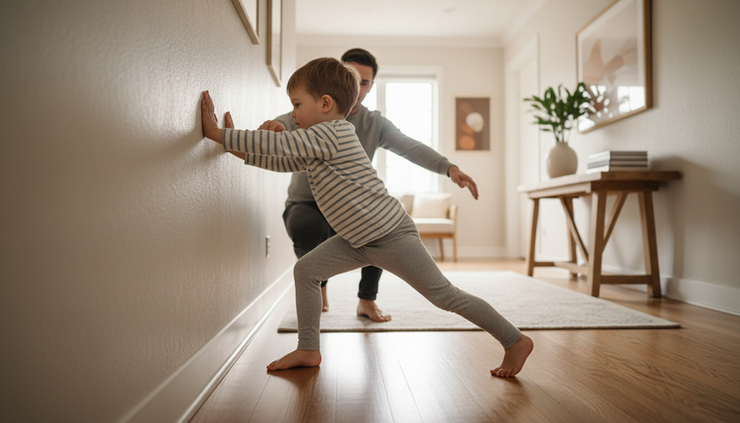
Stretching may help when the calf muscles or Achilles tendon are tight. A clinician or physical therapist can teach safe stretches that fit the child’s age and ability.
The best stretching routine is one the family can actually do. Short, consistent sessions often work better than long routines that become stressful. Stretching should not be forced or painful.
Physical therapy can retrain the walking pattern
Physical therapy can help children build strength, balance, coordination, and body awareness. Therapy may include gait training, stretching, strengthening, balance work, and play-based exercises.
For children who can walk flat-footed but default to tiptoes, therapy helps the brain and body practice a different pattern until it feels more natural.
Orthotics may support better foot and ankle position
Orthotics or braces may help some children keep the heel down and support a more stable walking pattern. The type of device depends on the child’s flexibility, age, foot shape, and severity of toe walking.
Some children need simple shoe inserts. Others may benefit from ankle-foot orthoses, often called AFOs, especially when more control is needed.
Orthotics work best when paired with stretching, therapy, and follow-up. The device supports the pattern, but the child still needs to learn how to move well.
Casting may be used for more significant tightness
Serial casting can help some children with limited ankle motion. During this treatment, casts gently stretch the calf and Achilles tendon over time. The casts are changed on a schedule determined by the treating clinician.
Casting is not for every child. It is usually considered when stretching and therapy are not enough, or when the child has a more fixed tightness that limits heel contact.
Surgery is reserved for select cases
Surgery is not the first step for most children. When a child has a significant Achilles tendon contracture that does not improve with conservative care, surgical lengthening may be discussed.
This decision requires careful evaluation. The goal is to improve ankle motion and walking function while avoiding overcorrection. Recovery may include casting, bracing, and physical therapy.
What parents can watch at home
A few simple observations can help during the appointment. Try to watch quietly rather than constantly reminding the child to walk flat. Children often change their gait when they know someone is watching.
Look for these patterns:
How often the heels touch the ground
Whether toe walking is worse barefoot or in shoes
Whether one foot stays higher than the other
Whether the child can squat with heels down
Whether the child gets tired quickly during play
Whether pain shows up after sports or long walks
Whether shoes wear out at the front faster than expected
A short video can also help. Record the child walking naturally from the front, back, and side. Keep it simple and brief. A natural walking clip can give the doctor useful information, especially if the child walks differently in the exam room.
What can happen if persistent toe walking is ignored
Some children outgrow toe walking. Others do not. When the pattern continues for years, the calf muscles and Achilles tendon may become tighter. The child may lose the ability to place the heels down comfortably.
Persistent toe walking can also place extra pressure on the front of the foot. Over time, that may contribute to pain, calluses, fatigue, balance problems, or difficulty with sports.
The body may compensate in other areas too. A child with limited ankle motion may turn the feet outward, bend the knees differently, arch the back, or change posture to move forward. These changes can affect comfort and function.
Early evaluation does not mean aggressive treatment. It means families get a clear explanation and a plan before the pattern becomes harder to change.
When to see a podiatrist
A podiatrist who treats children can assess the foot, ankle, Achilles tendon, gait pattern, and shoe needs. If you are searching for a toe walking podiatrist near me, look for someone who regularly evaluates pediatric gait concerns and can coordinate care when needed.
Families in Cypress, TX looking for help with toe walking Cypress TX can schedule an evaluation with Dr. Correa at Select Foot & Ankle Specialists. He can determine whether the pattern is likely developmental, related to tightness, or connected to another concern that needs additional care.
Bring your child’s regular shoes, any braces or inserts already used, and any videos you have of the walking pattern. If the child has seen a pediatrician, neurologist, physical therapist, or occupational therapist for related concerns, bring those details too.

A calm next step is better than guessing
Tiptoe walking is not always a problem. In toddlers, it is often part of learning to walk. But when it continues beyond age 2 or 3, happens most of the time, causes pain, or limits heel contact, it should be evaluated.
The good news is that many children improve with conservative care such as stretching, physical therapy, orthotics, and time. When treatment starts early, children often have more flexibility and more options.
This article is for general education and should not replace medical advice from your child’s healthcare professional. If your child’s walking pattern concerns you, a pediatric foot and ankle evaluation can help you understand what is happening and what to do next.


Comments